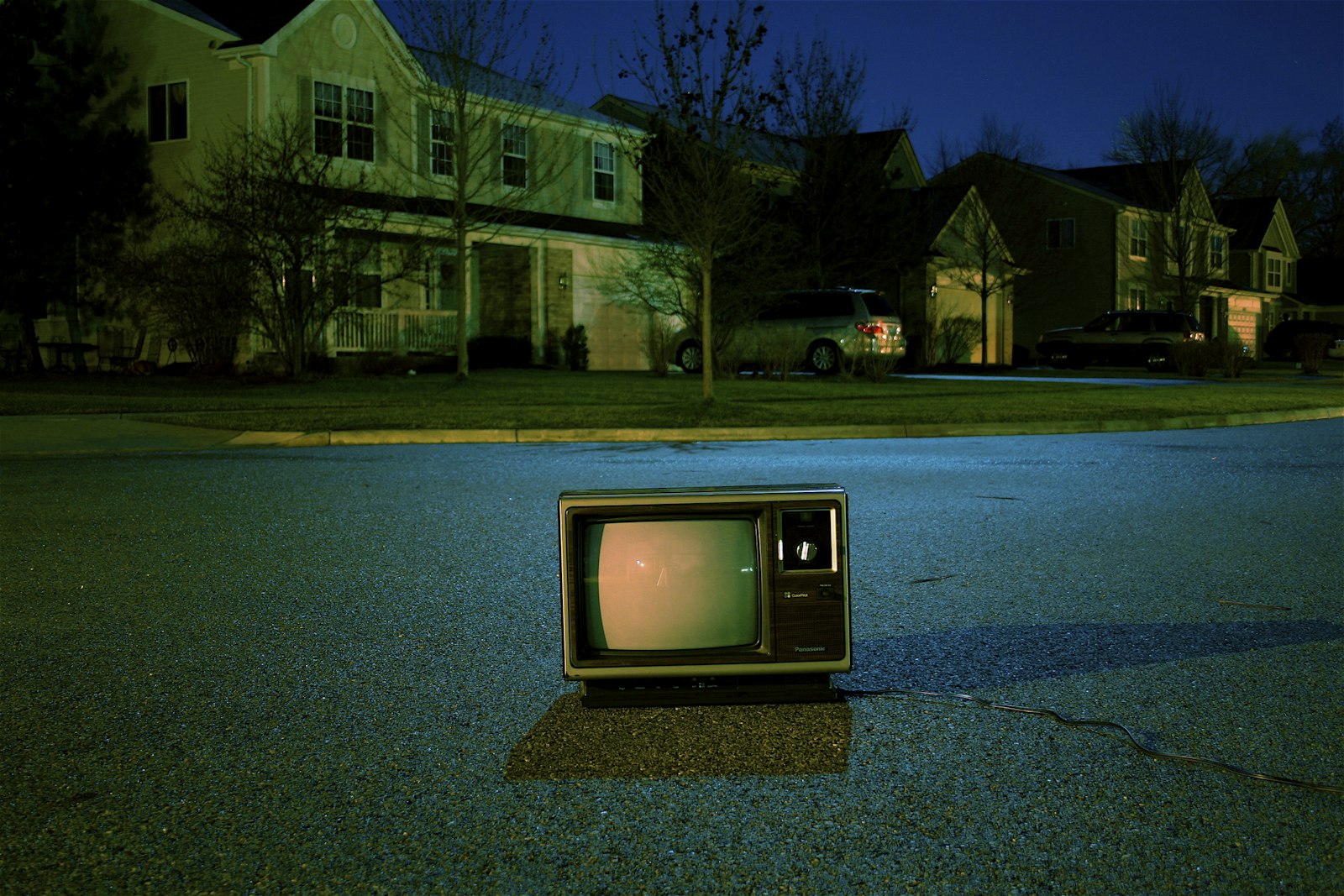
CLICK HERE. SIGN UP NOW. LIMITED TIME OFFER. BUY ONE GET ONE. SUBSCRIBE TODAY.
I'm tired. You're tired. We're all tired.
Modern advertising is loud. Obnoxiously, relentlessly, desperately loud. Every scroll, every click, every pause longer than two seconds is an invitation for something to shout at you. Pop-ups. Interstitials. Pre-rolls. Mid-rolls. Banners that follow you across the internet like a lost puppy with a megaphone.
And it's dying. Not quickly, not cleanly—but the model is cracking in ways that should make anyone in advertising pay attention.
The Golden Era Nobody Remembers
Before the thirty-second spot, before the jingle-bumper-jingle sandwich, television advertising worked completely differently. In the early days of TV—the late 1940s through the mid-1950s—most shows had a single sponsor. Not a rotation of advertisers fighting for thirty seconds. One brand. The whole show.
And the brand wasn't interrupting the show. It was the show.
Texaco Star Theatre. The Colgate Comedy Hour. Kraft Television Theatre. The Dinah Shore Chevy Show. The sponsor's name was literally in the title. The ad agency often produced the program itself. And the stars—the actual stars of the show—delivered the ads themselves, in their own voice, sometimes woven directly into the storyline.
Lucy and Desi would pull out Philip Morris cigarettes mid-scene and light up. George Burns and Gracie Allen kept Carnation milk visible in their kitchen and broke the fourth wall to sing its praises. Arthur Godfrey—maybe the most famous pitchman of the era—would toss aside the scripted ad copy and ad-lib: "Aw, who wrote this? Everyone knows Lipton's is the best tea you can buy." The audience believed him because it didn't feel like an ad. It felt like Arthur Godfrey genuinely liked the tea.
Jack Benny's writers scripted the Lucky Strike commercial into the middle of the episode as a comedy bit. Don Wilson, the show's announcer, would read the spot—and if he botched the slogan, the "trauma" became a running gag for weeks. The ad wasn't something you endured between entertainment. It was entertainment.
The Camel News Caravan required anchor John Cameron Swayze to keep a burning Camel cigarette in an ashtray on his desk for the entire broadcast. The man didn't even smoke.
This was the norm. One sponsor. Integrated delivery. The star is the pitchman. The pitch is part of the story.
What Killed It
Three things converged to end the golden era.
First, production costs. Television was far more expensive than radio. Fewer and fewer companies could bankroll an entire show by themselves. R.J. Reynolds pulled out of the Camel News Caravan in 1956 because even they couldn't justify the spend.
Second, NBC executive Pat Weaver introduced what he called the "magazine concept"—the idea that TV should sell advertising the way magazines sell pages. Multiple advertisers buying small blocks of time. No single sponsor. No editorial control. He launched Today and The Tonight Show on this model in the early 1950s, and it worked.
Third—and this was the kill shot—the quiz show scandals. Shows like Twenty-One and The $64,000 Question were rigged. Sponsors had pressured producers to keep popular contestants winning because ratings meant sales. When Congress investigated in 1959, the whole house of cards fell. Networks seized control of programming, single sponsorship died, and the thirty-second spot became the atomic unit of television advertising.
By the mid-1960s, the integrated model was gone. What replaced it was the interruptive model we've been living with ever since.
Sixty Years of Shouting
The interruptive model scaled beautifully for a world with three channels and no remote control. Where else were you going to go?
But then came cable. Then the internet. Then DVRs. Then streaming. Then ad blockers. Each new technology gave consumers one more tool to escape the shouting. And each time, advertisers responded by shouting louder.
Same Playbook, Every Screen
Here's the thing nobody talks about: the web didn't invent a new advertising model. It copied the old one and made it worse.
Television interrupted a thirty-minute show with two-minute commercial breaks. The web interrupted a 500-word article with banner ads, pop-ups, and interstitials that hijack your entire screen. The mechanism is identical. You came for the content. The ad stands between you and the content. Pay attention or you don't get to continue.
Mobile made it more aggressive. Those interstitial ads with the tiny, nearly invisible X button that you can't tap for five seconds? That's not advertising. That's hostage negotiation. Full-screen takeovers on a device you carry in your pocket, triggered by the act of opening an app you already chose to install. The commercial break followed you off the couch and into your hand.
Social media perfected the rhythm. Scroll through Instagram, TikTok, or LinkedIn and count. Every three to four organic posts—posts from people you actually follow—a sponsored post breaks the flow. It's dressed up to look like the content around it, but it's not. It's a commercial break. The exact same pattern as 1960s television: a few minutes of the thing you came for, then an interruption from someone who paid for your eyeballs, then back to the thing you came for. The cadence is nearly identical. They just replaced the bumper music with the word "Sponsored" in gray text.
Email inboxes became another feed to interrupt. Push notifications became the new cold call. Retargeting—where you look at a pair of shoes once and then see them on every website for three weeks—took the concept of a repeated TV commercial and made it feel like stalking.
The medium changed with each generation. The interruption didn't. From the first thirty-second TV spot in the 1960s to the sponsored post you scrolled past ten minutes ago, the fundamental premise has been the same: break up the thing the user wants with the thing the advertiser wants. Sixty years of innovation in how to deliver the interruption. Almost none in whether to interrupt at all.
The numbers tell us consumers have reached their limit. Over 912 million people now use ad blockers—and that number is expected to cross a billion by the end of this year. The top reason? Too many ads. Second place: ads are too intrusive. Third: privacy. People aren't just ignoring ads. They're actively building fortifications against them.
Meanwhile, 41% of consumers report subscription fatigue—the supposed escape hatch from ad-supported models. Nearly half of streaming subscribers think they're overpaying. 37% of Gen Z has canceled at least one streaming service specifically because of it. And here's a fun data point: consumers think they spend about $86 a month on subscriptions. The actual number is $219. People are bleeding money on subscriptions they don't even remember signing up for.
When razors and toothpaste became subscription products, I suspect a line was crossed.
The interruptive model is exhausting people across every screen they own. The subscription alternative is exhausting their wallets. Something has to give.
The Community Immune System
Anyone who's tried to self-promote on Hacker News or Reddit knows what happens when you bring loud advertising into a community that values signal over noise. They blow back. Hard.
The most famous example might be Woody Harrelson's Reddit AMA. His PR team tried to keep every answer focused on promoting the movie Rampart. The community revolted so completely that "Let's keep this about Rampart" became a permanent internet meme. The promotion achieved the exact opposite of its goal.
More recently, a marketing agency called Trap Plan published a case study bragging about planting 40+ fake posts across gaming subreddits for a client. Reddit users spotted the astroturfing, called it out, and the agency deleted its case study within 24 hours. The FTC fines companies up to $16,000 per day for that kind of thing.
These communities aren't anti-advertising. They're anti-loud. What actually works on HN and Reddit is genuine engagement. Offering thoughtful answers. Asking questions to understand someone's problem. And if—if—your product happens to be relevant, casually mentioning it when asked directly. Not leading with the pitch. Leading with the person.
It's less about the product and more about you and your problem. That's the model that works. And I think it's the model that's about to scale way beyond Reddit threads.
The AI Discovery Shift
Here's where things get interesting.
AI platforms—ChatGPT, Perplexity, Claude, Google's AI Overviews—now generate an estimated 45 billion monthly sessions worldwide. That's roughly 56% of global search volume. Google's share of search-related activity dropped from 89% to 71% in just two years. 60% of Google searches already end without a click. In AI Mode, that number hits 93%.
People are increasingly asking AI assistants questions instead of typing keywords into a search bar. And the AI doesn't serve a page of blue links with ads sprinkled in. It serves an answer. One answer. Maybe with a citation. Maybe with a product recommendation woven naturally into the response.
This is not a minor shift. This is the discovery layer being rebuilt from scratch.
New disciplines are emerging around it—AEO (Answer Engine Optimization) and GEO (Generative Engine Optimization). The premise: optimize your content not to rank on a search results page, but to be cited in an AI-generated answer. The AEO market alone is projected to reach $12.5 billion by 2032. A Princeton research paper published at KDD 2024 showed that specific content optimizations can boost visibility in AI-generated answers by up to 40%.
Commerce is already embedding into these conversations. ChatGPT launched shopping research and instant checkout—a full browse-compare-purchase pipeline inside the chat. Perplexity integrated with over 5,000 merchants through PayPal. And here's the stat that should make traditional advertisers nervous: AI search traffic converts at 14.2%, compared to 2.8% for traditional Google search. Five times higher.
The battle lines are already drawn. In January, OpenAI announced it would begin showing ads inside ChatGPT—contextual text ads appearing below responses, personalized based on your conversation topics. Their CFO Sarah Friar framed it at Davos as democratizing access: "Our mission is AGI for the benefit of humanity, not for the benefit of humanity who can pay." The interruptive model, migrating to the intelligence layer. OpenAI projects this will generate $1 billion in 2026, scaling to $25 billion by 2029. The economics are too seductive to resist.
Anthropic's response was immediate—and delicious. They spent an estimated $10 million on four Super Bowl commercials satirizing the concept. Each spot showed a person asking an AI chatbot something deeply personal—how to communicate with their mom, how to get in shape—only for the AI to pivot mid-answer into a bizarre sponsored pitch for a dating site or height-boosting insoles. The tagline: "Ads are coming to AI. But not to Claude."
The irony was not lost on anyone. Anthropic ran ads to tell people they wouldn't run ads. Sam Altman called it "clearly dishonest." Marketing analyst Scott Galloway compared it to Apple's legendary 1984 ad. It won the Super Clio. Claude's app shot into the top 10. Anthropic saw an 11% user boost.
But here's what matters for this argument: the campaign worked because the thesis resonated. People instinctively understood that an AI interrupting a conversation about your relationship with your mother to pitch a dating site was grotesque. Not because ads are inherently evil—but because the context was wrong. The intimacy of the conversation made the interruption feel like a violation.
That instinct—that context matters, that intimacy demands respect—is the entire point. The ad isn't an ad anymore. It's a contextual recommendation inside a conversation you're already having. That's not interruptive. That's what the 1950s model looked like—updated for the intelligence layer. And the companies that understand the difference between embedding commerce into context and injecting ads into intimacy are the ones that will earn trust in this new era.
The Lifetale Moment
I had this realization while working out the business model for Lifetale(see how I did that?), my new product—a heatmap-based journal that maps meaningful moments across the roughly 1,000 months of a human life.
The obvious business models didn't fit.
Traditional advertising? Lifetale is built around privacy. Intimacy. A small circle of close family and friends sharing real memories, not performative content. Slapping a banner ad between someone's birthday memory and their grandmother's letter would be obscene. It goes against the very ethos of the thing.
Subscriptions? We've established how consumers feel about those. Another $4.99/month charge competing with the dozen other subscriptions they've already forgotten about. Subscription fatigue is real, and I'm not interested in building a product people resent paying for.
A one-time purchase per major version? Better, but it creates a barrier to entry for an app that fundamentally needs network effects to work. Lifetale gets better when your circle is on it—your partner, your parents, your closest friends. A price tag at the front door slows that growth to a crawl.
So what do you do when the product costs money to run and the standard models either violate your values or don't fit your economics?
That's when I remembered the golden era.
The Restaurant Photo
Here's the example that crystallized it for me.
A user takes a photo at a restaurant, celebrating a birthday. They're capturing the moment—the cake, the candles, the people they love around the table. Later, they sit down and write about it. What they felt. What was said. The detail they want to remember in twenty years.
That photo and that memory live in a card on their Lifetale grid. A square colored by meaningfulness. Private. Intimate. Theirs.
Now—subtly, contextually, without breaking the moment—a small link appears in that card. "Book your next visit." A reservation link for the restaurant where the memory was made. Not a banner. Not a pop-up. Not a push notification screaming about a limited-time offer. A quiet, relevant, contextual invitation to recreate the experience.
That's the model. The ad is a service. It's useful. It's relevant. And it's embedded in a moment the user already cares about.
The restaurant didn't shout. It whispered. And the whisper works because it's speaking at the exact moment the user is already thinking about that place, already feeling warmth about what happened there.
The Principles
What I'm describing isn't new. It's a pattern. And it has clear principles:
Context over interruption. The recommendation appears where and when it's relevant—inside the user's own content, at the moment they're already engaged with the topic.
Utility over promotion. The link does something useful. It helps the user take an action they might actually want to take. It's not selling. It's serving.
Whisper over shout. The presentation is subtle. Small. Easy to ignore. It earns attention by being helpful, not by demanding it.
Privacy over surveillance. The recommendation is derived from the user's own content—a photo they took, a place they visited—not from tracking them across the internet. The data stays theirs.
These are the same principles that made the 1950s model work. Arthur Godfrey didn't shout about Lipton Tea. He mentioned it like a friend recommending something over dinner. The audience trusted him because the pitch respected their intelligence.
Where This Goes
I think we're at the beginning of a fundamental shift in how products reach people.
The interruptive model—born from the quiz show scandals and sixty years of inertia—is being dismantled by the same forces that built it: technology and economics. Ad blockers made the shouting ineffective. Subscription fatigue made the alternative exhausting. AI is rebuilding the discovery layer around conversation, not interruption.
The products that figure out contextual placement—real, useful, respectful contextual placement—are going to win the next era of monetization. Not because it's a clever trick, but because consumers are done being shouted at.
The loudest ad in the room isn't the most effective one anymore. It's the most ignored one.
The future is quiet. And I think it's going to work.
Building a product and struggling with monetization that doesn't compromise your values? I've been thinking about this problem a lot. Let's talk.